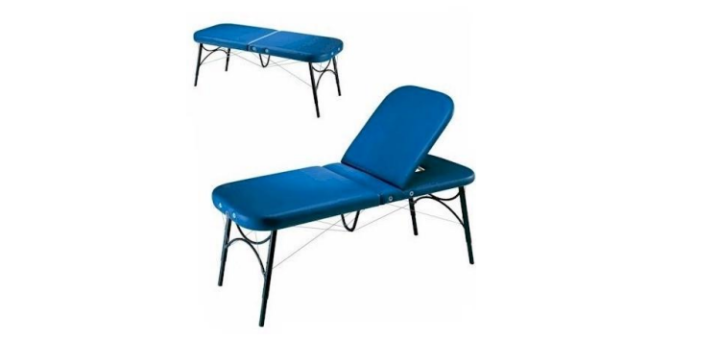
Designing a Day Surgery Table Around Patients, Clinicians and Clinical Practice
Medical equipment has to do more than perform a technical function. It needs to work for the people who use it, fit naturally into the clinical environment and, above all, support the patient experience.
That becomes particularly important when designing equipment for day surgery and ophthalmic procedures, where clinicians need precise access to the patient while the patient needs to remain comfortable, supported and correctly positioned.
For Cambridge Design Technology (CDT), developing a day surgery table provided an opportunity to bring these considerations together – taking a client’s initial concepts and developing them through design, engineering and iterative prototyping towards pre-production prototypes.
The project is a useful example of CDT’s approach to medical device development: understanding the practical requirements first, then using engineering and prototyping to turn those requirements into a workable solution.
Starting with the clinical environment
A successful medical product begins with an understanding of where and how it will actually be used.
A day surgery table might appear relatively straightforward, but its design needs to accommodate a number of competing requirements. Clinicians need good access to the patient and the ability to work effectively around the table. Patients need to be positioned securely and comfortably, often for a significant period of time. The equipment also needs to work within the constraints of a busy clinical environment.
For ophthalmic surgery in particular, positioning and accessibility are critical. The table needs to provide the stability and support required by the procedure while allowing clinicians to work in the positions they need.
These practical considerations shaped the development process from the outset.
Rather than designing around a set of purely technical specifications, CDT worked collaboratively with the client to understand what the product needed to achieve in practice.
Turning client concepts into engineered solutions
The development began with the client’s concepts and requirements, which were translated into detailed designs and engineering solutions.
At this stage, CAD modelling provided an important tool for exploring different approaches. It allowed the team to consider dimensions, mechanisms, materials, ergonomics and interfaces before committing to physical components.
But with a product such as a surgical table, digital design can only take the development so far.
The way a clinician reaches around a patient, the way a patient sits or lies on the table, how different components are adjusted and how the equipment fits into the clinical workflow are all things that can be much easier to understand when there is a physical prototype to interact with.
That is why prototyping formed an important part of the development process.
Designing for both patient and clinician
One of the central challenges was finding the right balance between patient comfort and clinical accessibility.
These requirements can sometimes pull the design in different directions.
Additional padding, support or adjustment may improve patient comfort, for example, but could potentially restrict access for a clinician. Conversely, creating maximum access around the patient needs to be considered alongside positioning, support and stability.
Good medical product design is about finding the balance rather than simply prioritising one requirement over another.
Through iterative development, CDT was able to explore these considerations and refine the design based on what worked in practice.
This is where user-centred engineering becomes particularly valuable. The product isn’t designed for an abstract ‘user’. It is designed around the different people who will interact with it and the specific environment in which it will be used.
Why prototyping matters in medical product development
A prototype is much more than a physical version of a CAD model.
It provides an opportunity to test assumptions.
With a physical prototype, the client and development team can assess the proportions of the product, how it feels to use, whether adjustments are intuitive and whether the various components work together as intended.
It can also highlight things that aren’t always obvious on a screen.
A control may be technically accessible but awkward to operate. A component may work perfectly in isolation but interfere with another part of the product. A particular position may look appropriate in CAD but prove uncomfortable or impractical when used with a real person.
Identifying these issues early gives the development team the opportunity to make changes before the design progresses further.
For CDT, this iterative approach is an important part of reducing development risk and creating products that work in the real world, rather than simply meeting a set of drawings or specifications.
From concept to pre-production prototype
The journey from an initial concept to a pre-production prototype involves much more than simply making the product look right.
As the design develops, manufacturing considerations also need to be taken into account. Component manufacture, assembly, materials, tolerances and the way individual parts come together can all influence the final design.
Bringing these considerations into the development process early can help identify potential issues before production.
It also means that the prototype is doing more than demonstrating the concept. It becomes a way of validating the engineering approach, testing the interaction between components and refining the product before it moves towards manufacture.
For this day surgery table, CDT took the client’s original concepts through this process of design development, engineering and prototyping, resulting in pre-production prototypes that could be evaluated and refined ahead of the next stage of development.
Collaboration throughout the development process
Medical product development rarely happens in isolation.
The most effective projects involve close collaboration between the client, designers, engineers, manufacturers and, where appropriate, the people who will ultimately use the product.
CDT’s role is to bring together these different considerations and help move a project forward – from early concepts and engineering development through to prototyping and production readiness.
Its wider medical device experience spans product, functional and engineering design, with capabilities including concept creation, 3D CAD modelling, prototyping, testing and product certification.
The day surgery table is a good example of why that joined-up approach matters. A successful product isn’t simply one that looks right or performs a technical function. It needs to fit into the environment around it, support the people using it and be engineered with its eventual manufacture in mind.
Designing medical devices around real-world needs
As Addenbrooke’s Hospital marks 260 years since it first opened its doors to patients in October 1766, it feels particularly appropriate to look at the role engineering and product design can play in supporting modern healthcare.
The technology used in healthcare has changed enormously over that time, but one principle remains important: products and equipment need to work for people.
For CDT, that means putting the realities of clinical practice at the heart of the development process.
From a client’s initial concept through detailed engineering, iterative prototyping and towards pre-production, the aim is to develop medical products that are practical, considered and engineered around the people who ultimately depend on them.
Developing your next medical device?
If you have a medical product concept that needs to be developed, refined or taken through to functional or pre-production prototyping, Cambridge Design Technology can support the process.
Find out more about CDT’s Medical Device Design capabilities or get in touch to discuss your next project.