Engineering One of the World’s Lightest Portable Treatment Couches
Lightweight Structures for Real-World Clinical Performance
In modern healthcare and therapy environments, portability is no longer a convenience – it is a requirement. From mobile practitioners to multi-site clinical teams, equipment must be easy to transport, quick to deploy and robust enough to perform reliably under repeated use.
However, reducing weight in medical equipment introduces a critical engineering challenge: how to maintain structural strength, stability and user confidence while minimising mass.
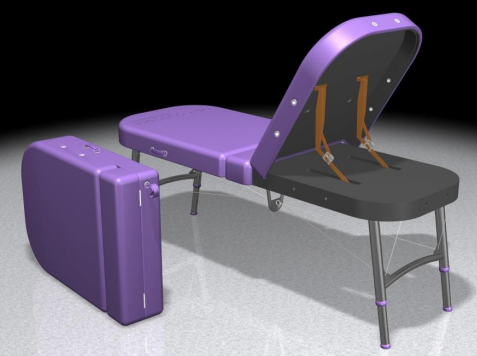
Cambridge Design Technology (CDT) was tasked with developing a portable treatment couch that pushes the boundaries of lightweight design, without compromising clinical usability or durability. The result is a highly engineered solution that weighs just 8.6kg and is marketed as one of the world’s lightest portable treatment couches.
This project demonstrates CDT’s expertise in lightweight structures, advanced materials and user-centred mechanical design.
Responding to the Demand for Ultra-Portable Medical Equipment
Healthcare delivery is increasingly mobile. Physiotherapists, sports therapists and clinicians often operate across multiple locations, requiring equipment that can be transported easily without sacrificing patient experience.
For a treatment couch, this creates a complex set of design requirements:
- ultra-low weight for portability
- high structural strength for patient safety
- stability during use
- durability across repeated folding, transport and setup cycles
- ease of handling for practitioners
Meeting these demands required a holistic engineering approach, combining material innovation with structural efficiency and ergonomic thinking.
Carbon Fibre Base: Engineering Strength Through Material Innovation
At the heart of the couch is a carbon fibre base, chosen for its exceptional strength-to-weight ratio.
CDT’s mechanical engineers carefully engineered the structure to maximise stiffness while minimising material usage. By analysing load paths and stress distribution, the team ensured the couch could withstand real-world clinical demands while remaining exceptionally lightweight.
Carbon fibre not only reduces mass but also delivers durability and fatigue resistance, making it ideally suited to equipment that must endure repeated handling, transport and setup.
High-Tensile Wire Frame: Rethinking the Leg Structure
Traditional portable couches rely on heavier, rigid leg assemblies. CDT reimagined this approach by developing a high-tensile wire leg frame structure.
This innovative system provides:
- strong load-bearing capability
- reduced material mass
- efficient force distribution
- compact folding geometry for transport
The wire frame works in tension rather than relying solely on compression, allowing the structure to remain stable and secure while using significantly less material than conventional designs.
This approach reflects CDT’s strength in intelligent mechanical systems — using physics and structural principles to achieve performance gains, rather than simply adding material.
Structural Analysis for Confidence at 8.6kg
Achieving a total weight of just 8.6kg required rigorous engineering validation.
CDT applied detailed structural analysis to ensure the couch performs reliably under real-world conditions, including patient loading and dynamic use. The design was iterated to maintain stability, resist deformation and meet appropriate safety factors for clinical environments.
This careful balance between weight reduction and structural integrity ensures the product delivers both portability and confidence in use.
Designing for Real-World Use: Portability Meets Usability
Lightweight design alone is not enough. The couch also needed to perform in real clinical environments.
CDT incorporated user-centred design principles to ensure the final product delivers:
- quick and intuitive setup
- comfortable patient positioning
- secure, stable feel during treatment
- compact folding for transport and storage
Every design decision considered the end user — from the practitioner carrying the couch between appointments to the patient experiencing treatment.
This focus on usability ensures that the engineering solution translates into genuine real-world value.
Balancing Performance, Durability and Practicality
One of the defining challenges of this project was balancing three competing priorities: reducing weight, maintaining durability and delivering a high-quality treatment experience.
Through intelligent material selection, efficient structural design and iterative development, CDT successfully achieved this balance. The couch is lightweight enough for effortless transport, yet robust enough to withstand repeated use without compromise.
Lightweight Engineering for High-Performance Products
This portable treatment couch project highlights Cambridge Design Technology’s ability to engineer high-performance products through intelligent material and structural choices.
From carbon fibre integration to innovative tension-based structures, CDT delivers solutions that achieve significant weight reduction without compromising strength, stability or usability.
For product teams operating in competitive markets, this approach enables:
- differentiated product performance
- improved user experience
- reduced transport and handling costs
- stronger market positioning
Partner with CDT on Your Next Development Programme
If you are developing portable, high-performance equipment and need to reduce weight without sacrificing reliability, CDT’s multidisciplinary engineering team can help.
Explore CDT’s Mechanical Design expertise, learn more about their Industrial Design and development capabilities, or get in touch to discuss your next project.
Contact Cambridge Design Technology today to discover how intelligent engineering can transform your product performance.